Select one of the options below:

Take your teaching, conducting, and musicianship to new heights with this unique program that combines an online curriculum with hands-on experience.
Take your teaching, conducting, and musicianship to new heights with this unique program that combines an online curriculum with hands-on experience. Designed for elementary, secondary, and independent music educators, this degree features on-campus participation in the annual Colorado Kodály Institute as an exclusive two-week residency each summer.
The online curriculum and summer sessions fit nicely into most teachers' schedules, allowing you to earn your master's in music education while continuing to work full time. The courses you will take online cover theory and research, while the on-campus summer institutes offer important interaction and the opportunity to apply the techniques and methods you have been studying. You will learn from faculty – some with more than 30 years of teaching experience – who are:
Upon completion of this program, you will not only have your master's in music education, but through the summer institute, you will have earned national Kodály music teaching certification as well.
The curriculum introduces the philosophy and teachings of Hungarian music educator Zoltán Kodály, emphasizing concepts like:
The annual Colorado Kodály Institute includes applied course sessions taught by some of the most prestigious music pedagogues from around the country. The two-week summer session gives you the opportunity to apply the theory and research you have learned in your online courses to real-world scenarios by practicing teaching techniques with local elementary students. By bringing together students and respected music educators, the program provides you with real-time feedback to bring your skills to the next level.
Equipped with both a Master of Music in Music Education degree and national Kodály teaching certification, graduates of this program have a unique edge in the job market. The skills and knowledge you gain earning these qualifications will help you be a leader in your profession, strengthening an entire school district's music program.
Many graduates go on to share their knowledge with other educators through professional conference presentations, workshops, and publications. Considered an advanced, specialized teacher training, national Kodály teaching certification is a highly sought-after attribute in the profession.
Completion of this unique program can also reveal leadership opportunities throughout regional, state, and national music teaching organizations, such as the Organization of American Kodály Educators, and the National Association for Music Educators.
See how the skills learned in the program help Alexandria and Kate teach musical concepts with fun and interactive games to inspire their students.
"This program has truly transformed who I am as teacher, musician, and human. It has altered the way I think about music and interact with it. I have also appreciated having the opportunity to return to the student role after being in teacher mode for the past 9 years. I am very appreciative to have had such intelligent and eloquently spoken role models to look up to. I hope I can carry myself with the same deportment that has been demonstrated for me. I certainly feel like a better, more confident, and capable teacher."
"The instructors are exemplary in their knowledge as well as their fair and consistent feedback. The curriculum is informative and useful, consistently relevant to our teaching positions. You will also form bonds with your fellow educators that will last a lifetime. I cannot recommend this program enough!"

Tanya LeJeune lives in Denver, Colorado, and has thirty years of music teaching experience. She has taught K–8th grade general music at Jefferson County Public Schools and Kodály Level I courses at the Colorado Kodály Institute at Colorado State University. Tanya is past president of ROCKE and has served as Member at Large for OAKE. She has served on the Elementary Music Curriculum Advisory Committee and as a teacher mentor for Jefferson County Public Schools. Tanya has presented music education workshops and in-services for several school districts, universities, and colleges in Colorado, as well as CMEA, AOSA Rocky Mountain Chapter, NWKE, ROCKE, ATKS, OKE, OAKE Western Division Conference, and OAKE. Tanya's most recent endeavor is the general music education podcast Music Teacher Coffee Talk, which she hosts with friend and colleague Carrie Nicholas.

Crystal Henricks currently teaches lower school music at the University of Chicago Laboratory Schools. Her experience includes Nursery School through 12th grade general and choral music, both in Chicago and China. She holds a BS in Music Education from Asbury University, Kodály Certification, and MMEd from Capital University, and is a Master Teaching Artist with the American Eurhythmics Society. She completed Levels I-III Orff Schulwerk Certification from the University of Kentucky and Anderson University. She is an active clinician for workshops throughout the United States. She has taught elementary music pedagogy and folk song research classes at Colorado State University, DePaul University, VanderCook College of Music, and the University of Central Missouri.

Carrie Nicholas is in her 25th year as an elementary general music specialist, currently teaching K-5 general music in Lakewood, CO. She received her bachelor’s degree of Music Education from Illinois Wesleyan University and a master’s degree of Music Education with Kodály Emphasis from Colorado State University, completing her Level III Kodály certification in 2005. In addition, Carrie has completed Dalcroze and Orff Level II training. She is an active presenter, having shared sessions and presentations for various school districts, county and state music education conferences, and OAKE chapters and conferences. Carrie is a proud member of OAKE and currently serves as Member at Large on the OAKE board. She is past president of ROCKE (the Regional Organization of Colorado Kodály Educators) and past president of the OAKE Western Division. Carrie has taught at the Colorado Kodály Institute and Seattle Kodály Levels Program as Level III Pedagogy and Folk Song Analysis instructor. Carrie co-hosts the podcast “Music Teacher Coffee Talk” with her colleague and friend, Tanya LeJeune.

Amanda Isaac is in her eighth year as the Director of Choirs at Bakersfield High School in Bakersfield, California, after enjoying over fifteen years in elementary & junior high settings. Choirs under her leadership consistently earn high ratings at festivals, and her students regularly participate in regional, all-state, division, and national honor choirs. Ms. Isaac earned both a B.A. and M.A. in Music from California State University, Chico, and Kodály Certification from McNeese State University. She enjoys leading honor choirs and workshops as well as serving her professional communities in a variety of roles.

Robert Lee is a classically trained pianist and educator with a keen interest in music education and collaborative piano. Robert holds a Bachelor of Music degree in piano performance from the University of Calgary and a Master of Music degree in Music Education with Kodály Emphasis from Holy Names University (HNU). Having lived in the San Francisco Bay Area for over a decade, Robert enjoyed building close connections within the music community. He has taught undergraduate, graduate, and continuing education classes at HNU, as well as musicianship classes, and has conducted and accompanied the San Francisco Boys Chorus. Robert is an active board member for organizations supporting music education, including the Northern California Association of Kodály Educators, the Organization of American Kodály Educators, and the Kodály Foundation for Music Education. Robert has taught summer Kodály levels at HNU, Wichita State University, Midwestern State University, and is keen to join the team at Colorado State University this summer.

Dr. Juhyun Lee is a pianist originally from South Korea, actively performing and coaching throughout the United States. She has participated in prominent programs such as the Bowdoin International Music Festival (ME), SongFest (CA), Luzerne Music Center (NY), National Flute Conference (DC/UT), International Horn Symposium (CO), Music on Site (KS), and the International Keyboard Odyssiad (CO), serving in various roles including fellow, guest artist, faculty member, adjudicator, music director, and coach. She built a strong foundation in woodwind repertoire while working with renowned saxophonist Kenneth Radnofsky from 2012 to 2015, serving as his studio pianist at the New England Conservatory, Boston University, and Boston Conservatory. Since then, she has expanded her collaborative work to include strings, brass, percussion, and voice through active professional engagements. She holds degrees in collaborative piano from the Longy School of Music (M.M.) and Arizona State University (D.M.A.). Dr. Lee is Assistant Professor of Practice at Colorado State University, where she has been on the faculty since 2018, coaching instrumentalists and vocalists and performing regularly in faculty and guest artist recitals.

Nicole Hallenbeck is a passionate music educator who has served Poudre School District and the Northern Colorado area for over 20 years. Nicole is the vocal music director at Wellington Middle-High School where she teaches a variety of vocal ensembles and music courses. Prior to her role in the secondary classroom, Nicole was the music teacher at Bennett Elementary, an I.B. World School, from 2004-2022. She enjoys being an active collaborator with the CSU Kodάly Institute, PSD mentor program, and has been an adjudicator for choirs in the Southern Colorado area. Nicole’s academic accomplishments include a Bachelor of Music Education degree from the University of Northern Colorado, and a Master of Music Education degree from Colorado State University, and is a certified level III Kodάly music educator. In addition to teaching, Nicole is one of three choral directors with Centennial Children’s Chorus and directs Cantare, which is an auditioned group of 5th-8th graders. Nicole is also a member of the Larimer Chorale and serves as the soprano section leader. Nicole shares her life with her two sons Nolan and Louis. Her time outside of education is spent delighting in outdoor activities, cheering at sporting events, and enjoying live music.

Professor Hedrick is committed to increasing equity and access to music education for underserved communities through helping students cultivate their personal musical collage as music ambassadors, producers, and performers. Her approach supports each individual’s interest, learning style, and identity. Katrina has been an active music educator since 2010 as a private instructor, in summer camps, and most notably serving as a middle and high school public school music teacher for a decade in high-impact rural and urban Colorado communities. As Adjunct Professor of Music Education, Katrina oversees the Elementary Music Education portion of the CSU’s Music Education Undergraduate Degree and serves as Interim Program Director of the Colorado Kodály Institute. Hedrick is also the Program Director of Spur Music Lab in Denver’s CSU Campus, a community outreach and teacher education center, and additionally supervises student teachers for Metropolitan State University. She is an active author, agent for social justice, multi-instrumentalist, and clinician for educators across the United States. Please connect with her at katrina.hedrick@colostate.edu.
This graduate degree is delivered online and on campus with a residency requirement of three two-week sessions in Fort Collins, Colorado each summer semester. These on-campus sessions include participation in the annual Colorado Kodály Institute as an exclusive two-week residency each summer.
This program gives you the flexibility to get the degree you want without a strict timeline, but still requires the same amount of work and time as an on-campus program. It is recommended that students allow nine to twelve hours per week for a three-credit course. This will vary depending on your learning and studying style.
Your interaction with the faculty and fellow students depends on the specific course. Online courses do provide you with online office hours and email contact. You also collaborate on projects and exchange ideas with fellow classmates through email and discussion board postings.
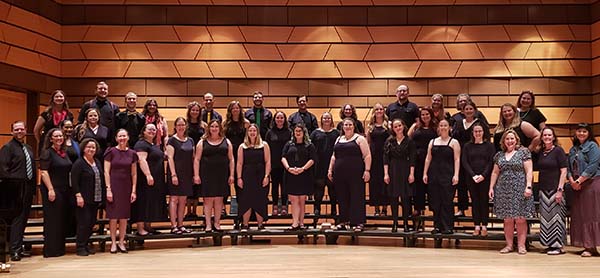
This program emphasizes a transformative approach to music education with a focus on equity, inclusion, and cultural sensitivity. Examples include:
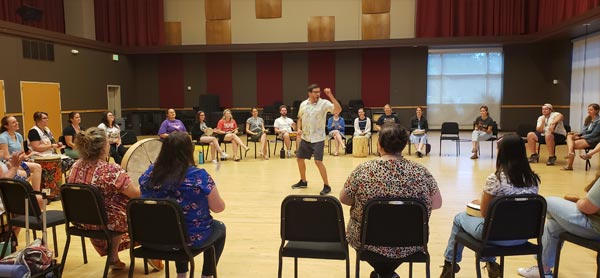
This program places a strong emphasis on cultivating leadership skills. CSU believes in empowering students to make a significant impact in the field of music education. Examples include:
Applicants must apply and be admitted by both the Graduate School and the School of Music, Theatre and Dance to begin this degree program.
You are required to complete 15 online graduate-level credits in addition to an on-campus summer residency program each summer. During your final semester of coursework, you must successfully complete a written and oral examination before the master's degree is awarded.
Our Kodály courses (MU 526A, B, C) are scheduled to take place July 11–24, 2026.
Through this graduate degree, you will take a variety of courses that cover topics such as pedagogy and folk song literature, folk song analysis and retrieval, conducting, Solfège/musicianship, and choir.
Note: Elective courses vary each semester. You will work with your advisor to choose three credits of approved electives. You may also be required to take additional coursework as determined by diagnostic examinations and/or your graduate advisor.
Earn a national certification in Kodály music teaching during the summer. Designed for elementary and secondary classroom music teachers, ensemble instructors, and independent music instructors, CSU’s Colorado Kodály Institute offers you a depth of knowledge around teaching, conducting, musicianship, and music education.
The Colorado Kodály Institute (CKI) is one of the select programs endorsed by the Organization of American Kodály Educators. CKI faculty are among the top experts in the United States, and the University Center for the Arts location, at the foothills of the Rockies, provides an inspiring setting for personal growth.
Kodály Certification is awarded through Organization of American Kodály Educators (OAKE) when a student has successfully completed all three Levels and can demonstrate expertise in their musicianship, conducting, and Kodály teaching. Upon successfully completing Level 1, students may be promoted to enter Level 2. Upon successfully completing Level 2, students may be promoted to enter Level 3. Promotion is determined on an individual basis by the Institute Faculty and Director according to the standards and guidelines set forth by OAKE.
The majority of participants in this program teach either part- or full-time during the school year, gaining relevant experience while pursuing their certification. As a result, they are continually assimilating real-world teaching experiences into their academic coursework.
Accepted students can take Level 1, Level 2, and Level 3 coursework for credit or noncredit
Want to go further with your music education? Learn more about CSU's online master's in music education program.
Note: The next Kodaly Summer Institute will take place July 2025.
| Summer semester | April 1 |
Start your application online and upload materials directly into the online system. You can save your progress and return any time.
Apply NowNote that meeting the minimum department standards does not ensure admission to the program. Admission to Colorado State University graduate programs is based on a number of factors, including prior academic and professional experience and the personal statement.
Prepare the materials below and upload when you apply online.
Complete the online graduate application and pay the nonrefundable application processing fee (payable online). As soon as you have completed the required information, please submit your application. Your application will not be reviewed until it is complete and all required materials have been received.
Request one official transcript of all collegiate work completed from all institutions attended. Transcripts from Colorado State University are not required. Transcripts must be received directly from the originating institution to be considered official.
Please Note: Students may be unconditionally admitted and registered in their first semester of courses with an unofficial transcript. Official transcripts must be submitted, prior to or during your first semester, before you can register for your second semester of graduate work. Failure to meet this condition will result in your dismissal from the Graduate School.
Electronic (preferred): Digital Transcripts must be submitted by the originating institution using a secure service such as parchment, eScrip-Safe, the National Student Clearinghouse, or e-Quals. Transcripts received via emails are considered unofficial. Use institution code 4075 for Colorado State University or gradadmissions@colostate.edu if the secure service requires an email address.
Mail (if necessary) Graduate Admissions Colorado State University – Office of Admissions 1062 Campus Delivery Fort Collins, CO 80523-1062
View your application status at any time to ensure your application checklist is complete or to check on updates.
Once your complete application, including supporting materials, is received, the department admission committee will review your application and notify you of their decision.
Proof of English language proficiency is required for applicants from countries or United States territories where there are official languages other than (or in addition to) English. This includes the U.S. territories of American Samoa, Guam, the Northern Mariana Islands, and Puerto Rico.
We love learning about your goals and answering any questions you have.